When Tommy Tremble Had His Helmet Ripped Off — And the No-Call That Followed
One of the most talked-about sequences from the Panthers’ Week 18 loss to the Buccaneers wasn’t a touchdown, a turnover, or even a game-winning drive. It was a single play in the third quarter when Buccaneers linebacker SirVocea Dennis grabbed Panthers tight end Tommy Tremble by the facemask and forcefully removed his helmet, yet no penalty was called. The Sun+1
For most fans and analysts, that moment became a flashpoint — not just because of what happened, but because of what it didn’t trigger: a flag. The helmet coming off a player in such a dramatic way is exactly the kind of situation the NFL’s safety rules are meant to address — and yet, on this occasion, the officials appeared to let it go. The Sun
Why Fans Noticed It
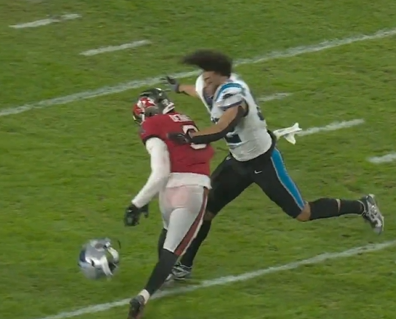
A facemask grab — especially one that forcibly removes a player’s helmet — normally draws immediate attention from officials because of the potential for injury and competitive impact. But in this game, it didn’t. Whether the referee crew simply missed the severity of the contact or judged that it didn’t rise to the level of a foul, the absence of a call drew widespread reaction from fans watching live and on social media. FanBuzz
Even commentators and fan-generated clips highlighted the moment, as the helmet removal was unmistakable on replay and was not followed by a flag. Reddit
Why This Sequence Matters
The reaction wasn’t just emotional — it was about consistency and context.
On the very next possession after the Tremble sequence, an offensive pass interference flag wiped out a long Panthers gain — a call that many observers also questioned. Taken together — a missed obvious foul and a controversial flag — these moments shifted momentum in a short span of plays and, to many observers, magnified the officiating’s role in the game’s outcome. The Sun+1
In a game with such narrow margins, the lack of a call on Tremble’s helmet being ripped off became a focal point for broader frustration.
Officiating Philosophy vs. Mechanical Application
One of the deeper challenges in understanding calls like this — or non-calls — is the gap between the rulebook and application. NFL officials are trained to look for certain criteria (e.g., forceful contact, grabbing, twisting) rather than the visual impact alone. In some cases, they may determine that a player’s motion or balance initiated helmet removal rather than a sustained mask grab — even if replay looks obvious to the viewer. That’s one of the reasons these plays become so controversial: the mechanics of officiating aren’t always transparent, and in high-stakes moments every interpretation matters more. FanBuzz
What It Says About Perception vs. Reality
Missed calls are part of football at every level. The difference in a game like this is not that a non-call occurred — it’s that it happened in a compressed, late-game environment where every yard and every moment felt magnified. When a sequence like the Tremble play coincides with other controversial decisions, emotions naturally rise, and narratives form quickly.
That emotional reaction doesn’t necessarily make the non-call the deciding factor, but it does illuminate why officiating remains a persistent talking point in close games:
- It impacts momentum
- It affects field position
- It influences down-and-distance
- And it shapes the narrative fans leave with
None of these are as simple as “good vs. bad” — but they are real contributors to how games are perceived and often, how they unfold. The Sun
Conclusion
The Tommy Tremble helmet non-call isn’t simply another missed moment. It’s a lens through which to view how officiating in the NFL is interpreted in the moment, how consistency matters, and how a sequence of decisions — or non-decisions — can shape the broader narrative around a game.
Whether you believe the no-call should have been made or not, the Tremble sequence is an example of why officiating conversations don’t disappear after a close loss — and why they continue to be a part of football’s most consequential games.